- Research
- Research Centers
- Journals
- Admission
- Introduction
- Programs
- Application
- Alumni & Giving
- Alumni Club
- Giving
At the invitation of the Global MOOC and Online Education Alliance Secretariat, Zhao Gang, a member of the Standing Committee of the CPC Beijing Foreign Studies University (BFSU) Committee and vice-president of BFSU, led a delegation to the 2025 Global MOOC and Online Education Conference in Mexico from Dec 2 to 3.
Zhao delivered a special report at the thematic session on "industry-education integration and the new global education ecosystem" on-site.
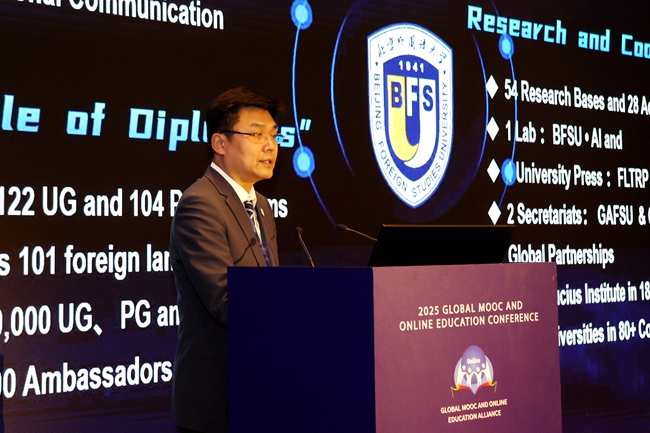
Zhao Gang delivers a special report at the 2025 Global MOOC and Online Education Conference in Mexico. [Photo/bfsu.edu.cn]
He highlighted BFSU's pioneering role as the first pilot university under the Chinese Ministry of Education's AI initiative for teacher development.
Zhao stated that BFSU is advancing innovative practices by leveraging its AI and its Human Language Key Laboratory to conduct research and publish works on AI and language. This includes developing systems like LingTrans101 for low-resource language translation and LingTutor, a digital teaching system.
He highlighted that BFSU is utilizing China's university foreign language MOOC platform to offer smart MOOCs in 18 languages, reaching over 1,000 universities and 4 million users. Zhao also introduced that the intelligent hub developed by the university can provide 24/7 learning support, and a smart teaching cloud platform integrating systems like "iWrite" for writing evaluation and "iTEST" for language testing.
During the conference, Zhao Gang and his delegation visited the Universidad Nacional Autónoma de México (UNAM). They held in-depth discussions on promoting student exchanges, developing online international cooperation projects, and jointly organizing academic and cultural events.
The 2025 Global MOOC and Online Education Conference was organized by the Global MOOC and Online Education Alliance and the UNESCO Institute for Information Technologies in Education, and hosted by Tsinghua University and UNAM. The conference attracted 180 representatives from 76 renowned universities, online education platforms, international organizations, and government agencies across 34 countries and regions. With the theme "Breaking boundaries and reshaping futures: Open and intelligent global education," the conference featured four thematic sessions and a global higher education AI future workshop. Discussions centered on topics such as the transformation of educational paradigms, the integration of industry and education, the new global education ecosystem, AI ethics and governance, and visions of educational quality and equity.




East Campus: No 2 Xisanhuan North Road, Haidian District, Beijing, China
West Campus: No 19 Xisanhuan North Road, Haidian District, Beijing, China